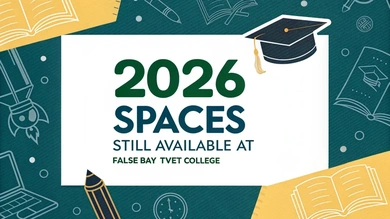
2026 spaces are still available at False Bay TVET College, Fish hoek Campus for various National Certificate Vocational (NCV) programmes. 2026 courses that still have space will close 06 February 2026 at False Bay TVET College. Students who have applied for NSFAS in 2025 will be prioritised.
2026 spaces still available at False Bay TVET College for the following NCV courses:
- Information Technology and Computer Science NCV L2-L4
- Programming and Robotics NCV L2-L4
NOTE: Interested applicants can submit their applications online via the False Bay TVET College Portal.
About NCV Information Technology and Computer Science (Levels 2–4):
The NCV Information Technology and Computer Science course is designed to equip learners with both foundational and advanced skills in computing and digital technology.
Across Levels 2, 3, and 4, the programme builds gradually from basic systems understanding to more complex competencies that are sought after in both the workplace and higher education.
What the programme covers:
- Computer fundamentals: understanding hardware, software, operating systems, and networks.
- Digital literacy: using essential applications such as word processors, spreadsheets, and presentation tools.
- Internet technologies: fundamentals of web usage, email communication, and online safety.
- Systems and applications: introduction to databases, basic programming logic, and systems management.
- Problem-solving: applying computational thinking to real-world tasks.
The programme offers a foundation for careers in:
- IT support and helpdesk roles
- Data entry and administration
- Junior technical roles in networking and systems
- Web and digital content support
- Preparation for further learning in software development and computer science
About NCV Programming and Robotics (Levels 2–4)
At False Bay TVET College, learners in the NCV Programming and Robotics courses have access to practical workshops where they build and test projects under instructor supervision.
These experiences reinforce classroom theory and help learners become comfortable with tools and software used in modern programming and automation environments.
What the programme covers:
- Computer programming: writing code using languages suited for beginners and robotics applications.
- Logical reasoning: computational thinking and problem decomposition.
- Robotics fundamentals: understanding sensors, actuators, and how robots interpret instructions.
- Automation basics: simple automated systems found in manufacturing, agriculture, and smart devices.
- Project design: hands-on work building or simulating small robotic systems.
The programme offers a foundation for careers in:
- Robotics integration and support
- Automated systems testing
- Junior programming and coding
- Educational technology deployment
- Entry-level roles in mechatronics or automation
These NCV courses are suitable for learners who have completed Grade 9, 10 or 11, making it accessible to students at different stages of their school journey. Successful completion of NCV Level 4 allows learners to enter the job market or pursue further studies (N4-N6).
The availability of spaces in both Information Technology and Computer Science and Programming and Robotics at False Bay TVET College reflects growing recognition of the importance of digital skills in South Africa’s economy.
With more industries seeking workers who understand computing, coding, automation, and system design, these programmes are positioned to offer learners a competitive edge.
Education experts note that TVET colleges are increasingly aligning their curricula with labour market needs, partnering with employers and technology providers to ensure graduates possess practical, job-ready skills. False Bay’s offerings in IT and robotics are part of this trend, opening doors to careers that didn’t exist on a wide scale just a decade ago.
Why consider False Bay TVET College?
One of the key advantages of studying at a TVET college is the strong link between training and employment. False Bay TVET College works closely with industry partners to ensure that its programmes remain relevant to current labour market needs. This means students graduate with skills that are more directly aligned with available job opportunities.
Another major factor is affordability. Students who want to study at False Bay TVET college will be funded by National Student Financial Aid Scheme (NSFAS), if they have already applied.