Stellenbosch University (SU) consistently ranks among South Africa's premier institutions, attracting ambitious students from across the nation and beyond. For those planning their 2027 academic journey, understanding which degrees offer the strongest career prospects is crucial. SU is renowned for its rigorous academic environment, equipping graduates with the critical thinking and technical skills demanded by today's competitive job market.
This guide highlights the degrees at Stellenbosch University expected to be most employable in 2027, based on current industry trends and SU's specialised offerings. We'll delve into what makes these fields stand out and provide essential details on how to apply to Stellenbosch University.
Top Employable Degrees at Stellenbosch University for 2027
Stellenbosch University's commitment to academic excellence translates into degrees that are highly valued by employers. For the 2027 intake, several fields stand out due to high demand in both national and global economies. These programs not only offer robust career opportunities but also equip students with specialized knowledge and practical skills.
1. Data Science and Analytics
In an increasingly data-driven world, professionals skilled in Data Science are invaluable. SU's offerings in this area, such as the Bachelor of Data Science (BDatSci), are designed to meet this demand. Graduates are prepared for roles in data analysis, machine learning, and artificial intelligence across various sectors. The estimated first-year fees for BDatSci were around R62,694 for 2025, with a projected R63,115 for BCom Data Science in 2026 (estimates, subject to change and excluding additional costs).
2. Engineering
Engineering remains a cornerstone of industrial development. Stellenbosch's Faculty of Engineering provides a wide range of specialisations, from Civil and Electrical to Mechanical and Industrial Engineering. These degrees are consistently sought after by companies involved in infrastructure, technology, and manufacturing. Specific admission requirements vary per discipline, generally requiring strong performance in Mathematics and Physical Sciences. Applicants are advised to consult the Engineering Yearbook for detailed requirements.
3. Medicine and Health Sciences
The Bachelor of Medicine and Bachelor of Surgery (MBChB) program at SU is highly competitive and leads to a career in a profession with perpetual demand. For the 2027 intake (based on 2026 guidelines), an NSC/equivalent aggregate of at least 75% (Level 6) is required, excluding LO, with a Mathematics score of at least 60% (Level 5), Physical Sciences at 50% (Level 4), and Life Sciences at 50% (Level 4). For the 2028 intake (based on 2027 matric results), these requirements increase to an 80% aggregate (Level 7), 70% in Mathematics (Level 6), 60% in Physical Sciences (Level 5), and 60% in Life Sciences (Level 5). Selection for MBChB is based on academic merit (80%) and a Situational Judgement Test (20%). Applicants for the MBChB programme are recommended to be 18 years or older by 1 February of their first year of study. Furthermore, applicants academically excluded from another tertiary institution or SU faculty will not be considered for MBChB.
4. Accounting and Commerce
Degrees within the Faculty of Economic and Management Sciences, particularly those focused on Accounting and Commerce, are essential for the functioning of any economy. Programs aimed at producing Chartered Accountants (CA(SA)) are especially valuable. SU's Bachelor of Accounting (BAcc) is recognised by SAICA, setting graduates on a path to significant financial careers. For the BCom (Management Sciences), an overall NSC average of at least 65% (excluding LO) is required, with a minimum of 60% in Mathematics and 50% in the language of instruction. The BCom (International Business) demands a higher overall NSC average of at least 80% (excluding LO), with 70% in Mathematics and 70% in English (or 80% if it's a First Additional Language), alongside proficiency in another language.
5. Computer Science
The digital revolution continues to drive demand for Computer Scientists. A BSc in Computer Science from SU equips graduates with the programming, software development, and theoretical computing skills needed for roles in the tech industry, cybersecurity, and beyond. Admission requirements typically include an NSC/IEB average of at least 65%, with Mathematics at 70% or higher and Physical Science at 50% or higher.
Applying to Stellenbosch University for 2027: Key Dates and Requirements
Applying to Stellenbosch University requires careful planning, especially for competitive programmes. Prospective students should be aware of the key dates and requirements to ensure a successful application for the 2027 intake.
Important Dates
- Undergraduate Applications Open: 18 April 2026
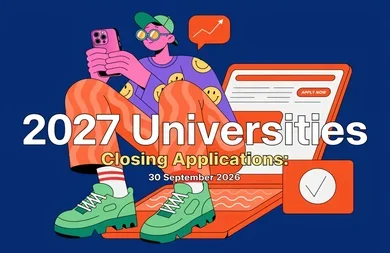
- Undergraduate and Residence Applications Close: 31 July 2026
- Financial Aid Application Deadline: Typically around 30 September 2026
- Postgraduate (MSc Machine Learning & AI) Applications Deadline: 31 October 2026 (for 2027 intake)
General Admission Requirements
All applicants need to meet the university's minimum entry requirements. This typically includes achieving at least 30% in the Language of Learning and Teaching (English or Afrikaans) and a minimum of Level 4 (50-59%) in four 20-credit subjects. Your National Senior Certificate (NSC) average calculation is based on your six best 20-credit subjects (excluding Life Orientation). Minimum admission requirements are strictly applied, and late applications are generally not considered.
Programme-Specific Requirements
Admission to popular programmes is highly competitive and often exceeds the minimum requirements. For example:
- BDatSci: Requires an NSC/IEB aggregate of 80% (excluding LO), with 80% in Mathematics and 60% in Afrikaans/English (Home Language) or 75% (First Additional Language).
- MBChB: As detailed above, this programme has stringent requirements for academic merit and specific subject percentages.
- BEng: Specific requirements vary per discipline, but strong performance in Mathematics and Physical Sciences is essential. Consult the Engineering Yearbook for details.
- BSc Computer Science: Typically needs an NSC/IEB average of at least 65%, with 70% in Mathematics and 50% in Physical Science.
- BCom (International Business): Demands an overall NSC average of at least 80% (excluding LO), with 70% in Mathematics, 70% in English (Home) or 80% (First Additional), and 70% in any additional language.
Always consult the official Stellenbosch University prospectus or faculty yearbooks for the most accurate and detailed admission criteria for the 2027 academic year.
Application Fees
A non-refundable application fee applies: R100 for South African citizens and residents, and R400 for international applicants. Ensure this is paid to complete your application. You can apply via the applicant portal or through the university's main website.
Tips for Aspiring Maties
Securing a place at Stellenbosch University, especially in highly sought-after programmes, requires more than just meeting the minimum requirements. Here are some tips to strengthen your application:
Excel Academically
Focus on achieving the highest possible marks in your Grade 11 and Grade 12 year. Pay close attention to the subjects that are prerequisites for your desired degree, particularly Mathematics and Physical Sciences for STEM fields. Provisional acceptance is often based on Grade 11 results, with final admission contingent on meeting Grade 12 requirements.
Understand the National Benchmark Test (NBT)
While not always mandatory for all programmes, familiarise yourself with the NBT. Strong NBT results can sometimes bolster an application, especially if your matric marks are borderline for a competitive programme.
Prepare Supporting Documents
Ensure you have all necessary documents ready, including certified copies of your ID and academic records. For postgraduate applications, a strong CV, letter of motivation, and statement of research interest are often necessary.
Apply Early
Applications open well in advance of the closing date. Submitting your application early can prevent last-minute technical issues and allow you to focus on finalising your documents. Remember that late applications are generally not considered.
Explore Financial Aid
If you require financial assistance, be sure to note the financial aid application deadline, which is typically at the end of September. Research bursaries and scholarships available through the university and external organisations.
Stellenbosch University continues to be a premier destination for students seeking degrees with strong career prospects. For the 2027 intake, fields like Data Science, Engineering, Medicine, Accounting, Computer Science, and Commerce stand out for their employability. Meeting the specific admission requirements and application deadlines is key to success.
By focusing on academic performance, preparing thoroughly, and understanding the application process, prospective students can significantly enhance their chances of being accepted into these highly rewarding programmes at one of South Africa's leading universities.