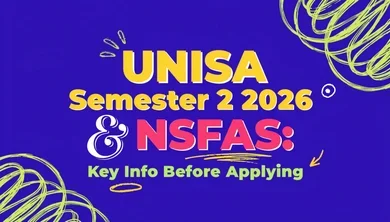
Thinking about applying to the University of South Africa (UNISA) for the second semester of 2026? If you're planning to rely on the National Student Financial Aid Scheme (NSFAS) for funding, it's vital to understand the specific and often narrow timelines involved. UNISA's application window for certain programmes opens in June 2026, but the critical point is that the NSFAS application period for 2026 likely closed much earlier. This timing difference can present a significant challenge for prospective students. This guide will walk you through the essential information you need to navigate the UNISA Semester 2 2026 application process, particularly concerning NSFAS funding and potential upfront costs.
Understanding the UNISA Semester 2 2026 Application Window
UNISA offers a mid-year intake for a selection of qualifications. These are typically higher-level qualifications such as honours degrees and postgraduate diplomas, as well as some undergraduate programmes that operate on 'Semester Modules'. The application period for these specific, limited qualifications is strictly scheduled from June 3, 2026, to June 17, 2026.
It is crucial to note that qualifications running on 'Year Modules', like the Bachelor of Education (BEd) or Bachelor of Laws (LLB) degrees, cannot commence in the second semester. If these are your chosen fields of study, you must apply for the January 2027 intake instead.
The NSFAS 2026 Funding Timeline Challenge
A common point of confusion is the timing of NSFAS applications. The general application period for NSFAS funding for the 2026 academic year typically closes between September 2025 and January 2026. This means that by the time UNISA's Semester 2 application window opens in June 2026, NSFAS applications for that year will almost certainly be closed.
Consequently, students accepted into UNISA for Semester 2 2026 who depend on NSFAS funding should be prepared for the possibility of paying the UNISA application fee and potentially an initial registration fee upfront. It's possible that NSFAS approval might only be confirmed after Semester 2 classes have already commenced in July 2026.
NSFAS Eligibility Criteria and What is Covered
To qualify for NSFAS funding, you must be a South African citizen or permanent resident. A key requirement is your household income, which should not exceed R350,000 per year. This limit is extended to R600,000 per year for applicants with disabilities. Crucially, you must also be accepted into a programme at a public university or TVET college that NSFAS covers.
NSFAS funding typically covers essential costs including registration fees, tuition fees, accommodation, transport, and a personal living allowance. While NSFAS aims to provide comprehensive support, it's important to be aware that it may not always cover the full extent of every student's expenses. Some students might need to cover certain costs themselves or make arrangements for additional funding.
UNISA Application Requirements, Fees, and APS Score
Applying to UNISA requires meeting specific academic prerequisites. This includes having a valid National Senior Certificate (NSC) or equivalent qualification and achieving the required Admission Point Score (APS) for your chosen qualification. It's important to remember that meeting these requirements does not guarantee admission, as spaces in popular programmes are limited.
The UNISA application fee is R150. This fee is non-refundable and must be paid by the application closing date. If you are accepted, UNISA may require a Minimum Initial Payment (MIP) as part of your registration fee. However, this upfront registration fee is typically waived for students who have confirmed NSFAS funding.
Essential Documents for UNISA and NSFAS Applications
For Your UNISA Application:
- Your South African ID document or Passport.
- Your National Senior Certificate (NSC) or equivalent results.
- If you have prior university study, certified copies of your tertiary transcripts.
- A SAQA certificate if you have qualifications obtained outside of South Africa.
- Marriage certificate or divorce decree, if applicable.
- Proof of Recognition of Prior Learning (RPL), if applicable.
- Please ensure all documents are scanned into PDF, DOC, or TIF format, and are under 2MB.
For Your NSFAS Application:
- Your South African ID document, or birth certificate if you are under 16.
- Copies of your parents' or guardians' ID documents.
- Your latest payslips, or an affidavit if you or your guardians are unemployed.
- Bank statements, if applicable.
- The completed NSFAS Consent Form.
- A Vulnerable Child Declaration form, if applicable.
- A Disability Annexure Form A, if applicable.
- Proof of guardianship or death certificates of parents/guardians, if applicable.
- Important Note: NSFAS no longer requires documents to be certified.
First-Year Experience (FYE) MOOC
All first-time UNISA applicants are required to complete the First-Year Experience (FYE) MOOC. This is a mandatory online course designed to help new students transition into university life and equip them with essential academic and personal skills. Ensure you register and complete this course as part of your preparation for studies at UNISA.
Applying for Multiple UNISA Qualifications
UNISA allows prospective students to apply for up to three different qualifications. This provides flexibility and increases your chances of being accepted into a programme that suits your academic goals. Make sure to carefully consider your options and list your preferences accurately on your application.
Successfully navigating the UNISA Semester 2 2026 application process, especially when relying on NSFAS funding, requires meticulous planning and an awareness of critical deadlines. Remember the very limited window for Semester 2 applications for specific UNISA courses and the fact that NSFAS applications for 2026 will likely have already closed. Be prepared for the possibility of covering the R150 application fee and potentially an initial registration fee upfront.
It's essential to thoroughly research the admission requirements for your desired qualification at UNISA and confirm that you meet all NSFAS eligibility criteria. Gathering all necessary documents in the correct format well in advance will significantly streamline your application process and move you closer to achieving your academic aspirations.
Ready to apply? Visit the official UNISA website and the NSFAS portal for the latest information and to start your application journey. Apply to UNISA | NSFAS