Securing financial aid is a critical step for many South African students aspiring to pursue higher education. The National Student Financial Aid Scheme (NSFAS) stands as a beacon of hope, providing crucial funding for eligible students at public universities and TVET colleges. As we look towards the 2026 academic year, it's never too early to understand the requirements and prepare your application meticulously.
The application window for NSFAS 2026 is set to open on September 1, 2025, and will close on January 31, 2026. This comprehensive guide will walk you through the essential eligibility criteria, including income thresholds, academic progression rules, and the vital documentation required to ensure your application is successful. Get ready to unlock your educational future with NSFAS.
Understanding NSFAS: Bridging the Gap to Higher Education
NSFAS is a government-funded scheme dedicated to providing financial assistance to South African students who come from poor and working-class backgrounds. Its mission is to ensure that deserving students are not denied access to higher education due to financial constraints. By covering tuition fees, accommodation, transport, and living allowances, NSFAS empowers thousands of students annually to achieve their academic dreams.
For the 2026 academic year, NSFAS continues its commitment to supporting students enrolled in undergraduate studies at any of the 26 public universities or 50 public TVET colleges across South Africa. Understanding its role and mandate is the first step towards a successful application.
The Core Eligibility Criteria for NSFAS 2026 Funding
Before delving into the specifics, it's important to grasp the foundational requirements for NSFAS funding in 2026. These criteria are non-negotiable and form the bedrock of any successful application:
- South African Citizenship or Permanent Residency: Applicants must be South African citizens or permanent residents.
- First-Time University/TVET Enrolment (mostly): While specific conditions apply for continuing students, NSFAS primarily supports students pursuing their first undergraduate qualification.
- Intention to Study at a Public Institution: You must be intending to register or already registered for an approved qualification at a public university or TVET college in South Africa.
- Financial Need: This is the cornerstone of NSFAS funding, determined by the household income threshold, which we will explore in detail.
Meeting these basic requirements is crucial before proceeding with your application.
Decoding the NSFAS Income Threshold for 2026 Applications
The financial eligibility criterion is often the most critical aspect of an NSFAS application. For the 2026 application cycle, the primary household income threshold remains a key determinant:
- General Household Income: Your combined annual household income (from all sources, including salaries, grants, and pensions) must not exceed R350,000 per annum. This amount is calculated based on the gross income of all individuals contributing to the household.
- Students with Disabilities: Recognising the additional financial burdens often associated with disabilities, students with disabilities qualify if their combined household income does not exceed R600,000 per annum. This higher threshold is a vital support mechanism for disabled students in South Africa.
- SASSA Grant Beneficiaries: If you are a recipient of a SASSA grant, you are automatically considered to meet the financial eligibility criteria, provided you meet all other non-financial requirements.
It's imperative to accurately declare all household income. Any misrepresentation can lead to disqualification or even legal repercussions. NSFAS uses various verification methods, including cross-referencing with SARS and other government databases, to confirm declared income.
Academic Progression Rules: Staying Funded Throughout Your Studies
NSFAS funding is not a once-off allocation; it's a commitment that requires students to maintain satisfactory academic performance. The academic progression rules ensure that public funds are invested in students who are committed to completing their studies:
- 50% Pass Rate Rule: In general, students are required to pass at least 50% of their registered modules in a given academic year to remain eligible for funding in the subsequent year. This rule encourages consistent effort and academic responsibility.
- N+1 Rule (TVET Colleges) & N+2 Rule (Universities): This rule refers to the maximum number of years NSFAS will fund a student for a qualification.
- For TVET colleges, NSFAS typically funds for the official duration of the qualification (N) plus one additional year (N+1).
- For university students, NSFAS will fund for the official duration of the qualification (N) plus two additional years (N+2). This accounts for potential academic setbacks or changes in study paths.
- No Repeating Courses Indefinitely: NSFAS will not fund students who repeatedly fail and re-register for the same modules beyond the N+1 or N+2 rule.
Prospective applicants should understand these rules from the outset to plan their academic journey effectively and ensure continued financial support.
Essential Documentation for a Successful 2026 Application
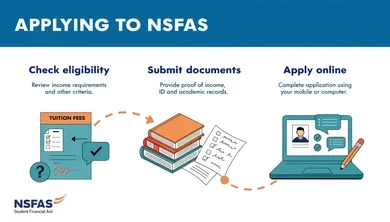
A critical component of a successful NSFAS application is submitting all required documents accurately and timeously. Incomplete or incorrect documentation is a primary reason for application rejections. For the 2026 application cycle, prepare the following:
- Certified Copy of Your South African ID: Your 13-digit barcoded ID document. If you are under 16 years old and do not have an ID, a birth certificate may suffice, but obtaining an ID is highly recommended.
- Certified Copies of Parents'/Guardians' IDs: IDs of both parents, or your legal guardian(s). If deceased, provide death certificates.
- Proof of Income:
- If employed: Latest payslips (not older than 3 months), or a letter of employment specifying income.
- If self-employed: An affidavit stating the nature of your business and estimated monthly income.
- If unemployed: An affidavit stating unemployment.
- If receiving grants: Proof of SASSA grant receipt (if applicable, though usually cross-verified).
- Proof of Residence: Utility bill or an affidavit from your local councillor confirming your address.
- Disability Annexure A: If you are a student with a disability, this form must be completed by a medical professional.
- Consent Form: A signed consent form allowing NSFAS to verify your information with relevant third parties (e.g., SARS).
- Spouse's ID and Income Proof: If married, your spouse's ID and proof of income are also required.
- Dependents' Information: If applicable, details of dependents in the household.
Ensure all copies are certified by a Commissioner of Oaths and are not older than three months. Start gathering these documents well in advance of the application opening date (September 1, 2025).
Navigating the 2026 NSFAS Application Process
Applying for NSFAS funding is primarily an online process. Here's a brief overview of what to expect:
- Create an Account: If you are a first-time applicant, you will need to create a myNSFAS account on the official NSFAS website.
- Complete the Online Application Form: Fill in all personal, academic, and household details accurately.
- Upload Required Documents: Systematically upload all certified documents as outlined above. Ensure files are in the correct format and legible.
- Submit Your Application: Once all sections are complete and documents uploaded, submit your application. You will receive a reference number.
- Track Your Application Status: Regularly log in to your myNSFAS account to monitor the status of your application. NSFAS will communicate updates and request additional information if needed.
Remember, the application period for 2026 runs from September 1, 2025, to January 31, 2026. Applying early is always advisable to avoid last-minute technical glitches or delays.
The prospect of higher education in South Africa is within reach for many, thanks to the invaluable support offered by NSFAS. By thoroughly understanding the eligibility criteria – from household income thresholds and academic progression rules to the crucial documentation requirements – you can significantly increase your chances of securing funding for your 2026 studies.
Start preparing now: gather your documents, understand the deadlines, and ensure every detail of your application is accurate. NSFAS is here to help you build a brighter future, and with careful planning, you can make the most of this incredible opportunity. Your academic journey awaits!