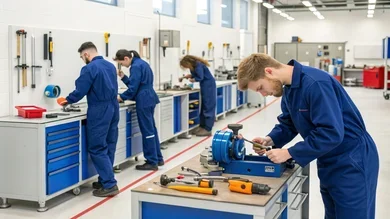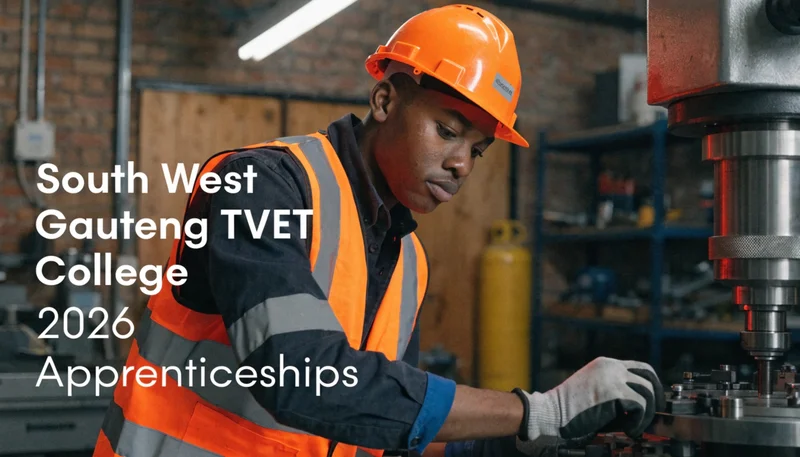
Unemployed young people looking to build technical skills and secure long-term career opportunities now have a new pathway to consider. South West Gauteng TVET College, in partnership with the FoodBev Manufacturing SETA, has announced the opening of its 2026 First Intake Apprenticeship Programme under its Centre of Specialisation initiative.
The programme is aimed at equipping local youth with industry-relevant technical skills in high-demand trades within the manufacturing and engineering sectors. The college confirmed that applications are now open, with the closing date set for 13 March 2026.
Trades Offered in the 2026 Intake
The apprenticeship programme will run over a period of 36 months, providing structured workplace training combined with theoretical instruction. The following occupational qualifications are available:
-
Occupational Certificate (OC): Fitter and Turner – 25 apprentices (Molapo Campus)
-
Occupational Certificate (OC): Mechanical Fitter – 25 apprentices (Molapo Campus)
-
Occupational Certificate (OC): Electrician – 10 apprentices (Roodepoort West Campus)
In total, 60 apprenticeship positions are available for the 2026 intake.
Minimum Entry Requirements
Applicants must meet specific academic requirements depending on the trade applied for.
For Fitter and Turner and Mechanical Fitter, candidates must have:
-
Grade 12 with Pure Mathematics (Technical subjects are an added advantage),
OR -
NCV Level 2–4 in Fitting and Turning (all 21 subjects completed),
OR -
N2–N6 Mechanical Engineering qualification (including Fitter and Turner trade theory).
For Electrician, applicants must have:
-
Grade 12 with Pure Mathematics (Technical subjects are an added advantage),
OR -
NCV Level 2–4 in Electrical Infrastructure and Construction (all 21 subjects completed),
OR -
N2–N6 Electrical Engineering qualification.
In addition, applicants must be under the age of 35 years.
Preference and Selection Process
The college indicated that preference will be given to former students who completed their studies at South West Gauteng TVET College. However, all qualifying applicants are encouraged to apply.
All candidates will undergo a formal assessment process as part of the selection criteria. Successful applicants will enter into the relevant ETQA agreement and an official employment contract for the duration of the apprenticeship.
This structured approach ensures that learners receive both accredited training and practical workplace exposure, increasing their employability upon completion.
Supporting Local Youth Employment
Youth unemployment remains one of South Africa’s most pressing challenges, particularly among young people with technical qualifications but limited workplace exposure. Apprenticeship programmes such as this one play a crucial role in bridging the gap between classroom learning and industry requirements.
By partnering with FoodBev Manufacturing SETA, the college aligns its training with sector-specific needs in manufacturing and engineering, ensuring apprentices are prepared to meet current industry standards.
The Centre of Specialisation model further strengthens this effort by focusing on priority trades identified as critical for economic growth and infrastructure development.
How to Apply
Interested applicants must submit the following documents:
-
An application letter clearly stating the trade being applied for
-
A comprehensive Curriculum Vitae
-
Certified copy of ID
-
Certified copies of qualifications
-
Proof of address
-
Proof of account (where applicable)
Applications must be submitted at the South West Gauteng TVET College before 13 March 2026. Late applications will not be considered.
For enquiries, applicants may contact the Molapo or Roodepoort West campuses during normal working hours (07h30 – 16h00).
A Valuable Career Opportunity
With 60 apprenticeship spaces available and a strong industry partnership backing the programme, the 2026 intake offers a significant opportunity for young people seeking to establish themselves in skilled technical trades.
Prospective applicants are encouraged to prepare their documentation early and ensure they meet all minimum requirements before submitting their applications.
As technical and artisan skills continue to be in demand across various sectors, programmes like this not only support individual career growth but also contribute to addressing the country’s broader skills shortage.