If you missed the standard TUT (Tshwane University of Technology) application deadlines for 2026, don’t lose hope just yet — there is still a chance to apply late! Tshwane University of Technology occasionally reopens its online application portal in January 2026 to accept late applications for programmes that still have available spaces.
In this blog post, we will walk you through:
What courses are still open for 2026 late applications
Admission requirements & application tips
How to check and apply
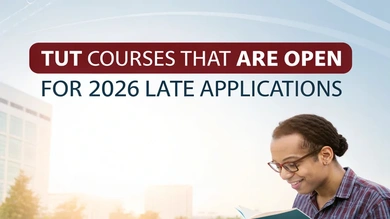
TUT Courses That Are Open for 2026 Late Applications
These courses are currently open at TUT for 2026 late applications:
- BEngTech (Materials Eng) (Polymer Tech)
- (Electrical Engineering)
- Dip (Electrical Engineering
- HCert (Electrical Engineering
- Dip (Credit Management)
- Dip (Industrial Physics)
- BSc (Industrial Chemistry)
- Dip (Analytical Chemistry)
- Dip (Biotechnology)
- Dip (Food Technology
- Dip (Computer Systems)
- Dip (Multimedia Computing)
- Dip (informatics)
- Diploma in Accounting
- Diploma in Building Science
- Diploma in Public Affairs
- Diploma in Entrepreneurship
- Diploma in Horticulture
- Bachelor of Education Honours in General Education and Training
More Information About Open Courses at TUT for late applications 2026
BEngTech (Materials Engineering – Polymer Technology)
This degree focuses on the science and engineering of plastic and polymer materials. Students learn how polymers are designed, processed, tested, and used in industries such as manufacturing, automotive, packaging, medical products, and construction.
BEngTech (Electrical Engineering)
This qualification trains students to design, develop, test, and maintain electrical systems and equipment. It covers power systems, electronics, control systems, and renewable energy technologies.
Diploma in Electrical Engineering
The diploma focuses on practical and theoretical skills needed to work with electrical installations, machines, and systems. Students learn about electrical circuits, power distribution, electronics, and safety regulations.
Higher Certificate in Electrical Engineering
This is an entry-level qualification designed to introduce students to the basics of electrical engineering. It covers foundational mathematics, electrical principles, and basic technical skills.
Diploma in Credit Management
This course focuses on managing credit, debt, and financial risk within organisations. Students learn about credit laws, debt collection, financial analysis, and customer account management.
Diploma in Industrial Physics
Industrial Physics combines physics principles with real-world industrial applications. Students study mechanics, electronics, materials science, and measurement systems used in manufacturing and technology-driven industries.
Bachelor of Science (Industrial Chemistry)
This degree focuses on applying chemistry in industrial and manufacturing environments. Students learn about chemical processes, production methods, quality control, and safety standards.
Diploma in Analytical Chemistry
This course trains students to analyse chemical substances using laboratory techniques and instruments. It focuses on testing, quality assurance, and data interpretation.
Diploma in Biotechnology
Biotechnology combines biology and technology to develop products and solutions in healthcare, agriculture, and environmental management. Students learn laboratory techniques, microbiology, genetics, and bioprocessing.
Diploma in Food Technology
This qualification focuses on the processing, production, safety, and quality control of food products. Students learn about food chemistry, microbiology, packaging, and legislation.
Diploma in Computer Systems Engineering
This course focuses on the design and maintenance of computer hardware, networks, and embedded systems. Students learn programming basics, electronics, networking, and system integration.
Diploma in Multimedia Computing
Multimedia Computing combines technology and creativity. Students learn about graphic design, video production, web development, animation, and digital media systems.
Diploma in Informatics
This qualification focuses on information systems, data management, and business technology solutions. Students learn programming, databases, systems analysis, and project management.
Diploma in Accounting
The diploma provides a strong foundation in financial accounting, management accounting, taxation, and auditing basics. Students learn how to prepare financial records and analyse business finances.
Diploma in Building Science
This course focuses on construction technology, building materials, project planning, and site management. Students learn how buildings are designed, constructed, and maintained.
Diploma in Public Affairs
Public Affairs focuses on government operations, public policy, communication, and community engagement. Students learn how public institutions function and how policies are developed and implemented.
Diploma in Entrepreneurship
This qualification is designed for students who want to start and manage their own businesses. It covers business planning, marketing, finance, innovation, and small business management.
Diploma in Horticulture
Horticulture focuses on plant production, landscaping, crop management, and environmental sustainability. Students learn about soil science, plant care, pest control, and greenhouse management.
Bachelor of Education Honours in General Education and Training (GET)
This postgraduate qualification is designed for qualified teachers who want to advance their teaching knowledge and leadership skills. It focuses on curriculum development, education research, assessment, and teaching strategies within the GET phase.
Important Notes About Late Applications at TUT
Submitting a late application does not mean you will automatically be accepted. TUT only opens late applications for courses that still have available spaces after the main application process is completed.
Even if a course appears on the late application list, spaces may close at any time once capacity is reached. This is why applying as early as possible during the late application window is extremely important.
Late applications do not lower entry requirements. Every applicant must still meet the minimum admission criteria for the programme they are applying for. TUT will not consider applications from students who do not meet these requirements, regardless of space availability.
During late applications, TUT often uses a first-come, first-served approach, but academic performance still plays a role. If many students apply for a small number of remaining spaces, preference may be given to applicants with higher marks or stronger subject results.
Tshwane University of Technology 2026 Late Application Link
Final Tip for Late Applicants
Late applications at TUT should be viewed as an opportunity that requires speed, preparation, and careful course selection. By meeting all admission requirements, applying early, and staying informed through official TUT platforms, students can maximise their chances of securing a place for the 2026 academic year.
Related Articles
Mangosuthu University of Technology Late Applications
University of Fort Hare Late Applications
Durban University of Technology Late Applications
Walter Sisulu University Late Applications
University of KwaZulu Natal Late Applications
Cape Peninsula University of Technology Late Applications
University of Zululand Late Applications
University of Venda Late Applications
Tshwane University of Technology Late Applications
Central Application Office Late Applications
University of South Africa Late Applications
University of Johannesburg Late Applications
University of Limpopo Late Applications
University of Pretoria Late Applications