For many South African students, funding is the deciding factor between accessing higher education or putting their studies on hold. Two of the most common sources of financial support are bursaries and the National Student Financial Aid Scheme (NSFAS). While both aim to make education more affordable, they are not the same.
Understanding the difference between bursaries and NSFAS can help students and parents make informed decisions when planning for university or TVET college studies.
What Is NSFAS?
NSFAS is a government-funded financial aid scheme designed to support students from poor and working-class households. It primarily assists students who would otherwise not be able to afford tertiary education at public universities and TVET colleges in South Africa.
NSFAS funding is needs-based, meaning eligibility is determined by household income and financial circumstances. In recent years, NSFAS has moved from offering loans to providing bursaries for qualifying students. This means that, provided students meet academic progression requirements, they do not have to repay the funding.
NSFAS covers tuition fees, accommodation (subject to limits), meals, learning materials, and a monthly living allowance. However, funding is only available at public institutions, and students must meet specific academic and financial criteria each year to continue receiving support.
What Is a Bursary?
A bursary is a form of financial assistance usually offered by private companies, government departments, state-owned entities, non-profit organisations, and sometimes universities themselves. Unlike NSFAS, bursaries are not run by a single national body and vary widely in terms of eligibility, coverage, and obligations.
Some bursaries are merit-based, awarded to students with strong academic performance, while others are need-based or targeted at specific groups, such as students from rural areas, women in science fields, or learners studying scarce skills like engineering, teaching, or healthcare.
Bursaries may cover tuition fees only, or they may include accommodation, books, meals, and even a stipend. Each bursary programme sets its own rules, application process, and conditions.
Key Differences Between NSFAS and Bursaries
One of the main differences between NSFAS and bursaries lies in who offers them. NSFAS is funded by the South African government and administered nationally, while bursaries are offered by a wide range of organisations, both public and private.
Eligibility criteria also differ. NSFAS focuses heavily on household income and financial need, with strict income thresholds. Bursaries, on the other hand, may consider academic performance, field of study, demographic background, or a combination of factors.
Another major difference is the level of flexibility. NSFAS funding is standardised, with fixed allowances and rules that apply to most students.
Bursaries are more flexible, but this also means they can come with additional conditions, such as work-back agreements. A work-back agreement requires students to work for the sponsoring organisation for a set period after graduating.
Repayment and Obligations
NSFAS-funded students do not repay the funding as long as they comply with academic requirements and complete their studies within the allowed timeframe. There is no obligation to work for the government after graduation.
Bursaries are generally non-repayable, but many come with obligations. Some require students to maintain a certain academic average, while others include compulsory vacation work or post-graduation employment with the sponsor. If a student fails to meet these conditions, the bursary may be converted into a loan that must be repaid.
Application Processes
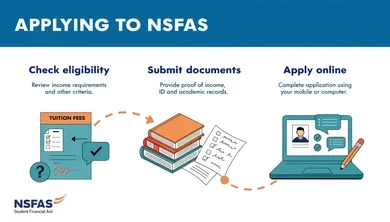
Applying for NSFAS involves completing an online application during the official application window, usually once a year. Students must submit supporting documents, including proof of income and academic records. Because NSFAS serves a large number of applicants, processing delays and appeals are common.
Bursary applications vary significantly. Each bursary has its own opening and closing dates, required documents, and selection process. Some bursaries are highly competitive, with limited spaces, while others are less well known and attract fewer applicants.
Can a Student Have Both?
In most cases, students cannot receive full NSFAS funding and a full bursary at the same time. However, some bursaries may be partial, covering only specific costs, and institutions may adjust funding accordingly. Students are required to disclose all funding sources to avoid complications or cancellation of support.
Which Option Is Better?
There is no simple answer to whether NSFAS or a bursary is better. NSFAS is often the most accessible option for students from low-income households and provides comprehensive support across public institutions. Bursaries, however, can offer additional benefits, such as career opportunities, mentorship, and guaranteed employment after graduation.
For many students, the best approach is to apply for both NSFAS and bursaries. Doing so increases the chances of securing funding and provides alternatives if one application is unsuccessful.
________________________________________
Both NSFAS and bursaries play a critical role in expanding access to higher education in South Africa. While they share the goal of supporting students financially, they differ in structure, eligibility, and obligations. By understanding these differences, students can better navigate the funding landscape and take a proactive approach to securing their educational future.