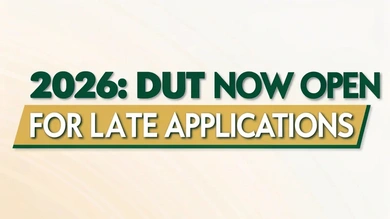
The Durban University of Technology (DUT) is currently accepting late applications for selected 2026 programmes. News students are advised to take advantage of this opportunity to apply. DUT applications for 2026 can be submitted online via the DUT application portal.
DUT’s decision to open late applications reflects ongoing demand for higher education opportunities, particularly in high-growth fields linked to technology, engineering, business, health sciences, and applied sciences.
A second opportunity for 2026 applicants
2026 Late applications at DUT are aimed at applicants who meet the minimum admission requirements but were unable to apply during the main application window in 2025.
This includes learners who recently received their final matric results, those who initially applied elsewhere and were unsuccessful, and individuals who only recently decided to pursue further studies in 2026.
Programmes Still Available at DUT for 2026:
- Bachelor of Applied Science in Industrial Chemistry
The Bachelor of Applied Science in Industrial Chemistry at the Durban University of Technology is a career-focused qualification designed to prepare students for work in chemical, manufacturing, and industrial environments.
The programme emphasises practical laboratory work alongside theoretical knowledge, making it ideal for students interested in applied science rather than purely academic chemistry.
What You Will Learn
Industrial chemical processes and applications
Analytical and laboratory chemistry techniques
Quality control and assurance
Chemical safety, health, and environmental compliance
Research methods and data analysis
- Bachelor of Design in Visual Communication Design
The Bachelor of Design in Visual Communication Design at DUT focuses on developing creative professionals for the graphic design, branding, and digital media industries.
The programme blends creativity, technology, and communication, preparing students for the fast-evolving design sector.
What You Will Learn
Graphic and digital design principles
Visual storytelling and branding
Typography and layout design
User experience (UX) and interface design
Design software and production techniques
- Bachelor of the Built Environment (Architecture)
The Bachelor of the Built Environment in Architecture at DUT introduces students to architectural design, construction methods, and the built environment. The programme is structured to combine creative design thinking with technical and environmental considerations.
What You Will Learn:
Architectural design and drawing
Construction materials and methods
Environmental and sustainable design
Architectural history and theory
Computer-aided design (CAD)
- Bachelor of Engineering Technology in Industrial Engineering
The Bachelor of Engineering Technology in Industrial Engineering focuses on improving systems, processes, and productivity in industrial and manufacturing environments. DUT’s applied approach equips students with practical engineering skills aligned with industry needs.
What You Will Learn:
Production planning and control
Operations management
Quality and systems engineering
Logistics and supply chain principles
Engineering economics
- Diploma in ICT in Application Development
The Diploma in Information and Communication Technology in Application Development is one of the most popular ICT qualifications at DUT. It prepares students to design, build, test, and maintain software applications for various platforms.
What You Will Learn:
Software and application development
Programming languages
Database design and management
Systems analysis and testing
Web and mobile application development
- Bachelor of the Built Environment (Geomatics)
The Bachelor of the Built Environment in Geomatics at DUT equips students with skills in land surveying, spatial data analysis, and mapping technologies. This programme focuses on accurate data collection and management, essential for construction, urban planning, and environmental monitoring.
What You Will Learn:
Surveying and geospatial data collection
Geographic Information Systems (GIS)
Remote sensing and photogrammetry
Land development and cadastral studies
Data analysis and reporting for construction and urban planning
- Bachelor of the Built Environment (Construction Studies)
The Bachelor of the Built Environment in Construction Studies is aimed at producing professionals skilled in managing construction projects, understanding structural design, and overseeing construction operations. DUT emphasizes applied knowledge and industry-ready skills.
What You Will Learn:
Construction management and planning
Project costing and budgeting
Structural design principles
Building codes and regulations
Practical site management
- Bachelor of the Built Environment (Urban and Regional Planning)
The Bachelor of the Built Environment in Urban and Regional Planning trains students to design, manage, and improve urban spaces, balancing social, environmental, and economic needs. DUT’s programme combines theory, fieldwork, and community-focused planning projects.
What You Will Learn:
Urban and regional development planning
GIS and mapping for planning
Sustainable development practices
Policy, law, and municipal planning
Community engagement and project management
- Bachelor of Engineering Technology in Power Engineering
The Bachelor of Engineering Technology in Power Engineering focuses on electrical power generation, distribution, and management systems. DUT provides a hands-on approach, preparing students for South Africa’s energy and industrial sectors.
What You Will Learn:
Electrical power systems and generation
Transmission and distribution technologies
Renewable energy integration
Electrical machines and control systems
Safety, standards, and regulatory compliance
- Bachelor of Engineering Technology in Electronic Engineering
The Bachelor of Engineering Technology in Electronic Engineering prepares students to design, develop, and maintain electronic systems used in communication, computing, and automation. DUT emphasises both theoretical knowledge and practical laboratory work.
What You Will Learn:
Electronic circuits and devices
Digital systems and microprocessors
Communication systems
Control systems and automation
Practical problem-solving through lab projects
- Bachelor of Health Sciences in Environmental Health
The Bachelor of Health Sciences in Environmental Health equips students to monitor, assess, and improve public health through environmental interventions. DUT combines classroom instruction with practical community and fieldwork.
What You Will Learn:
Environmental health risk assessment
Food safety and hygiene
Waste management and sanitation
Public health policy and regulation
Community health education
How to apply for late applications at DUT
All late applications must be submitted online through the DUT application system or the Central Applications Office. Applicants are required to complete the online application form and upload certified copies of the following documents:
- South African ID or passport
- Latest academic results (Grade 11 final or Grade 12 results)
- Proof of residence (where required)
What happens after applying?
After submitting a late application, applicants should regularly check their application status online. DUT may request additional documents or information during the evaluation process. Successful applicants will receive an offer, which must be accepted within the specified timeframe to secure the space.
Failure to accept an offer on time may result in the offer being withdrawn and allocated to another applicant.
Final reminder
With 2026 late applications now open at DUT, prospective students are encouraged to act quickly and responsibly. While space is limited, this application window provides a crucial second chance for those determined to further their studies at a reputable public institution.
Applicants are advised to rely only on official DUT communication channels for updates and to avoid third-party misinformation. As the academic year approaches, timely action could make the difference between securing a place and missing out.